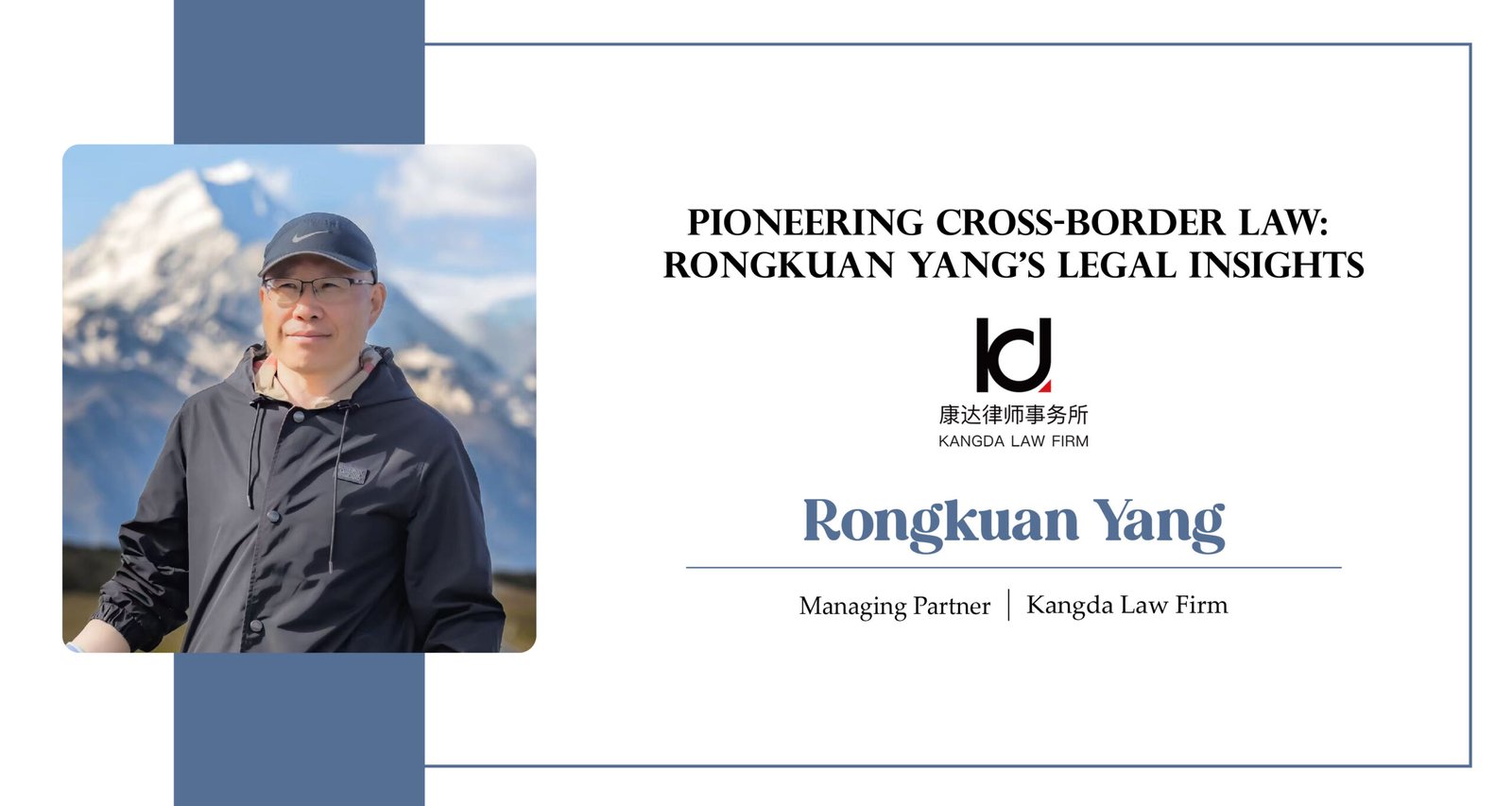

In the dynamic legal realm, Rongkuan YANG stands out as a beacon of expertise, innovation, and legal excellence. As a Senior Partner at Beijing Kangda Law Firm (“Kangda”) and the Director of its Hong Kong branch, he specializes in commercial law, with a focus on cross-border commercial dispute resolution. With over two decades of experience, YANG has earned a stellar reputation as a trusted advisor and litigator, handling high-profile cases that have shaped the judicial landscape.
A Lifelong Pursuit of Justice: YANG’s Inspiration
As a child, YANG found inspiration in history books and dramas, many involving legal themes. These planted in him the idea that law could address suffering, right wrongs, and seek justice. He grew determined to study law, applying only to law faculties.
For YANG, law is about helping ordinary, especially disadvantaged, people find support against injustice. Practicing since 1999, he views the profession as a meaningful, ongoing challenge, bringing successes and valuable experience over the years.
YANG’s Leadership Journey
YANG’s involvement with commercial disputes began to take on a Hong Kong dimension around 2003. In 2017, he had the opportunity to study in Hong Kong, which allowed him to observe and understand the city up close. He realized that cross-border commercial disputes were highly aligned with his expertise and interests.
Commercial legal relationships emphasize concepts such as efficiency and the protection of transactions—how to maintain the order of those transactions. This is quite different from criminal or civil thinking. In commercial dispute resolution, the mindset is crucial: beyond efficiency and effectiveness, many cases require him to integrate multiple ways of thinking.
Today, many of their cases are cross-border. In addition to applying the commercial thinking rooted in the civil law tradition of mainland China, international arbitration demands a strong grasp of common law reasoning. The ability to navigate different legal systems is critical to resolving disputes effectively. He recalls a cross-border case in 2004, when such disputes were relatively rare. The client’s contract stipulated arbitration at the Hong Kong International Arbitration Centre (HKIAC). At the time, the client was startled—it felt distant and daunting. Looking back now, some of their cases have even been selected as representative examples by HKIAC, showing how experience accumulates step by step.
Ultimately, commercial disputes require not only legal reasoning but also cultural understanding. The combination motivated him to lead Kangda Law Firm’s Hong Kong office.
The Art of Imperfection: Defining Moments
YANG believes a lawyer’s growth is defined by time, requiring years of experience and patience to let cases mature. Many matters demand long periods of refinement before they are crafted into something meaningful. Yet law is never perfect—every case carries some flaws, some unfinished artistry. That imperfection drives lawyers to push beyond limits, step by step, without arrogance.
Over his career, YANG has gathered insights and lessons, sharing them with law students and serving as a part-time professor and master’s supervisor at several leading institutions like Renmin University of China Law School, China University of Political Science and Law, Zhongnan University of Economics and Law, and Capital University of Economics and Business.
For YANG, the true value of a legal professional lies in reflection and sharing. It is not only a privilege but also a responsibility.
Navigating Complexity in Cross-Border Disputes
Cross-border commercial transactions inevitably involve different legal systems, cultures, mindsets, procedures, and ways of thinking. Commercial activity is not only an economic act but also a social phenomenon, intricately connected with everyday life, technology, and broader social relations.
Because of this, cross-border commerce is tied not only to commercial law and logic but also to wider societal and jurisdictional factors. Legal safeguards in such transactions demand caution and precision, with a strong emphasis on integrity and contractual commitments. At its core, dispute resolution must honor the client’s genuine hard work and effort—this is the responsibility placed upon lawyers.
Resolving cross-border disputes is, in essence, a two way journey of engagement and interaction, often involving multiple parties. It is a process of shared challenges and shared progress, where lawyers and clients move forward together, with resilience and solidarity.
Approach to Balancing Law and Business
According to YANG, legal services, particularly in the sphere of dispute resolution, cannot be treated as perfectly ‘precise’ products. ‘Legal facts’ established through evidence and judicial determination may approach ‘objective truth,’ but can never fully converge. This gap is a fundamental frustration of dispute resolution.
An exceptional legal team does not offer guaranteed outcomes or absolute promises. Instead, they exhaust every possibility within the legal framework to provide a wide array of remedies and strategic paths. This is especially true when a client feels they have reached an impasse. YANG’s team thrives in these ‘dead-end’ scenarios, finding a ‘light at the end of the tunnel’ for clients when all hope seems lost. Such breakthroughs result from collective perseverance, not predetermined certainty.
The Latest Trends in China’s Legal Sector
YANG highlights a key trend in China’s legal sector today—the implementation of the PRC Ecology and Environment Code, set for August 15, 2026. This new Code supersedes the old Environmental Protection Law and marks a major milestone for the industry. What stands out is its focus on human-centric growth and sustainability, particularly regarding the circular use of industrial energy and resources. For businesses operating in China or engaged in cross-border trade, this Code is set to become an essential guiding framework for future development.
The Impact of Globalization
YANG notes that globalization is the bedrock of cross border commercial legal services; without it, the field simply would not exist. The increasing complexity and evolution of international trade dictate the scope, specialization, and trajectory of these legal practices.
Conversely, cross-border legal services act as both a safeguard and an anchor for international business outcomes. They significantly enhance the standardization and stability of global commerce. The two are symbiotic and inextricably linked. While globalization is rarely smooth sailing, it remains an irreversible tide.
Navigating the Expansion Challenges
YANG highlights that as Chinese law firms go global, they face a wide range of hurdles, with culture shock being the most critical. Since legal rules are deeply rooted in local culture, what is considered standard practice in Mainland China might be rejected or seen as a violation abroad. To deliver truly excellent legal service, one must first achieve a mastery of the local cultural and legal landscape. This understanding is the essential foundation upon which everything else is built.
Mentoring the Next-Generation Lawyers
YANG emphasizes that the cornerstone of a visionary lawyer is the ability to practice true empathy to treat the client’s objectives as if they were one’s own. Excellence is defined by providing diligent, meticulous service that consistently strives to surpass the client’s expectations.
The root of their high standards lies in solving problems while deeply respecting party autonomy. YANG believes legal service is not merely a shield for protecting interests; it is a vehicle for transactional expectations. Their role is not only to provide redress for infringed rights but also to proactively maximize the client’s broader commercial objectives.
Essential Qualifications for YANG’s Success
YANG believes that the absolute bedrock of a legal career is reliability. While it sounds simple, true reliability is multi-dimensional. A document must never contain a typo. What may seem like a trivial error is, in fact, a glaring red flag—a manifestation of a lack of professional rigor.
Second, one must resist the temptation of ‘shortcuts’ or superficial cleverness. Relying on such tactics can easily become a psychological crutch, which inevitably leads to catastrophic professional failures. YANG recalls a lawyer who had a 9:00 AM hearing but didn’t wake up until 5:00 PM; that is an extreme example of being unreliable that the next generation must strictly avoid.
Third, law is a profession defined by the scale of time. It is not a career of overnight success. One must put in the ‘hard yards’ rather than banking on sheer luck. By cultivating discipline and building a solid foundation, professional ideals will naturally come to fruition. Finally, young lawyers must remain agile learners, possessing the curiosity to embrace new developments and the speed to master them.
The Future Roadmap for Kangda HONG KONG Law Firm
YANG notes that building a legacy is never a smooth journey. Kangda Hong Kong has navigated through periods of great hardship, emerging with a wealth of experience and a solid portfolio of achievements. Future challenges are inevitable, yet the firm remains steadfast. What defines them is their refusal to chase quick wins; they have maintained a distinct professional identity and a long-term perspective. With stability as their compass and excellence as their goal, they continue to move forward with unwavering confidence