
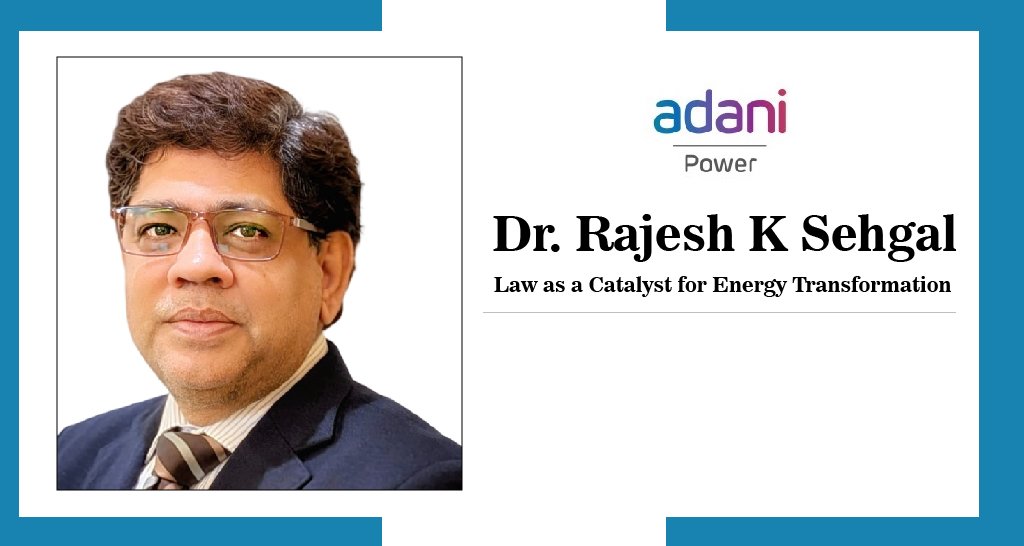

Adani Enterprises’ Chief Legal Officer on steering governance, dispute management, and compliance in an era of energy transition and global sustainability mandates.
In an era where energy transition and sustainability dominate global discourse, legal leadership has become a strategic cornerstone for growth. Dr. Rajesh Sehgal, Chief Legal Officer – Energy Business at Adani Enterprises, brings over 27 years of expertise in energy law, Dispute management, and cross-border acquisitions.
Ranked among India’s Top 100 GCs and recognized by Legal500 and Forbes, Dr. Sehgal shares his insights on navigating complexity, driving compliance, and shaping the future of energy governance.
What inspired you to specialize in legal practice within the energy and infrastructure sector — and ultimately take on the role of Chief Legal Officer.
at a major firm like Adani Power?
Energy and infrastructure are the backbone of economic development. Early in my career, I realized how legal frameworks can unlock or constrain growth in these sectors. Joining Adani Power was a natural progression—its scale and ambition aligned with my vision of integrating governance, compliance, and innovation in a sector critical to national progress.
How has your background shaped your approach to legal leadership in a complex, highly regulated industry?
My academic foundation—Ph.D. in law from Campus Law Centre, LL.M from Southampton (UK), and a diploma in environmental law—gave me deep insight into regulatory and sustainability issues. Global exposure across India, the Middle East, and Asia-Pacific taught me to navigate diverse legal systems and cultural contexts. Today, I emphasize proactive compliance, cross-functional collaboration, and risk-based governance.
What personal qualities or values guide your decision-making under pressure?
Integrity is non-negotiable. Transparency and resilience help me stay calm and decisive under uncertainty. Strategic foresight ensures that decisions balance immediate risk with long-term sustainability.
How do you balance risk management, compliance, and business strategy?
I follow a three-tier approach: mandatory compliance, strategic alignment, and governance excellence—supported by robust monitoring systems and effective dispute management framework.
What legal or governance challenges are unique to large-scale energy companies in India and Asia?
Regulatory volatility, energy transition risks, and managing litigations are major challenges. Over the next decade, expect digitized compliance, strong corporate governance, and effective dispute management to become standard.
How do you ensure Adani Power remains legally robust and ethical while pursuing aggressive growth?
We strengthen board-level governance, implement compliance-by-design, maintain transparent ESG reporting, and foster a culture of ethics and accountability.
How is the legal function evolving with environmental compliance and sustainability?
Legal is moving from a reactive compliance role to a strategic enabler—advising on green hydrogen, renewables, and carbon markets; structuring sustainability-linked financing; and deploying reg-tech tools for real-time monitoring.
What legal trends and challenges do you anticipate in Asia’s energy transition?
Hybrid contracts, carbon credit integrity, supply chain diligence, and environment litigation will dominate. Legal frameworks must adapt to ensure ethical sourcing and defensible sustainability claims.
How will the role of legal officers evolve by 2030?
Legal officers will become risk architects, ESG stewards, strategic partners in energy transition, and digital leaders leveraging AI and analytics for compliance and governance.
What legacy do you hope to build?
For Adani Energy Business: a governance framework admired for resilience and ethical growth. For the profession: demonstrating that legal leadership can be strategic and sustainability-driven. For society: proving that large-scale energy development can coexist with environmental responsibility and community welfare.