
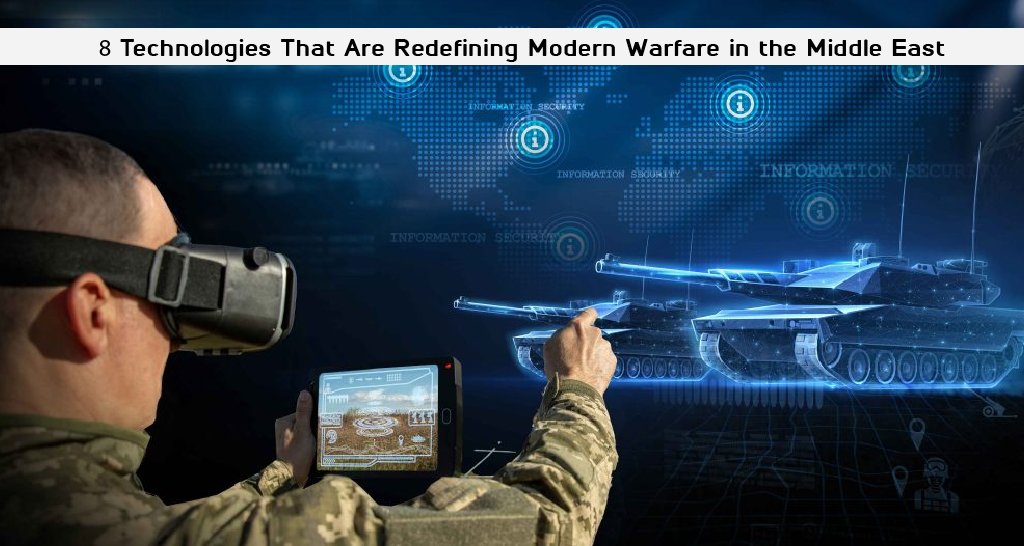

Advanced technologies that are changing the way wars are fought are having a bigger impact on the recent conflicts in the Middle East. High-tech instruments that improve accuracy, speed, and intelligence-gathering are replacing old-fashioned military techniques. Modern military operations rely heavily on new technology, from self-driving drones to cyber warfare. These eight technologies are changing the way wars are fought in the Middle East today.
- Armed Drones and Unmanned Aerial Vehicles (UAVs)
Drones are now one of the most powerful weapons in modern warfare. People employ these unmanned aircraft for spying, reconnaissance, and targeted attacks. They may stay in the air for a long time, giving real-time information and letting the military keep an eye on enemy movements. Armed drones also let you attack with pinpoint accuracy without putting pilots in danger. In recent wars, even cheap drones have been able to break through traditional military defences, making them a deadly weapon in both state and non-state confrontations.
- Artificial Intelligence in Battlefield Strategy
Artificial intelligence is being used more to look at large volumes of data as more data is received from satellites, drones, and ground sensors. Artificial intelligence systems can swiftly make sense of this information, which helps commanders find possible threats, keep an eye on the enemy’s movements, and plan military operations in a more thorough way. Artificial intelligence helps military personnel deal with the constantly changing situations on the battlefield by letting them make choices more quickly. AI methods can also help organise missions and find targets in certain situations.
- Precision-Guided Missiles
As a result of the significant advancements in missile technology, defensive strikes are now significantly more accurate. Advanced tracking technologies such as radar, infrared sensors, or satellite guidance are utilised by precision-guided missiles to successfully reach their intended targets. Militaries can destroy big structures or hostile sites with this technology, causing less harm to other things than they would be able to with conventional weaponry.
- Advanced Air and Missile Defense Systems
It is becoming increasingly frequent for space weapons such as rockets, ballistic missiles, and drones to be used, which means that the region requires additional and improved security systems. Tracking networks and interceptor weapons are examples of high-tech technologies that make it feasible to locate and eliminate potential dangers before they have a chance to cause harm.
- Laser and Directed-Energy Weapons
Laser systems and other directed-energy weapons are being used more in military security. To destroy drones, rockets, and other air threats, these tools send out very directed beams of energy. The speed of light is what laser weapons can hit, and each blast costs a lot less than a regular interceptor rocket. Laser defence systems will likely be used more in the future to protect military and civilian places because they work quickly and well.
- Cyber Warfare Capabilities
Cyber warfare is now an important part of modern wars. Governments and military groups are increasingly using cyberattacks to disrupt communications networks, damage infrastructure, or acquire information about their enemies. Cyber-attacks can hit communication networks, military command networks, power grids, and financial systems. Cyberattacks can happen without any physical fighting, which is different from traditional warfare. However, they can still cause a lot of harm to the economy and operations.
- Electronic Warfare and Signal Jamming
Electronic warfare technologies are made to control or mess with the electromagnetic spectrum that communication systems, radar, and navigation devices employ. Electronic warfare instruments are used by the military to block hostile transmissions, mess with radar systems, and cut off drone connections. Electronic warfare can limit the enemy’s capacity to do their job without having to fight them directly by making it harder for them to talk to each other or find their way around.
- Autonomous and AI-Powered Combat Systems
Another big change in modern warfare is the advent of autonomous combat systems. Artificial intelligence can let unmanned combat vehicles and planes work with regular military equipment to do things like spying, electronic warfare, and even attacking. These technologies can work with little help from people, which means they can work in dangerous places where sending in human soldiers would be too dangerous.
Conclusion
The fast growth of military technology is changing the way wars are fought in the Middle East. Drones, AI, cyber capabilities, and directed-energy weapons are some of the tools that are transforming how conflicts are planned and fought. Military personnel may now work with more accuracy, efficiency, and speed than ever before, thanks to modern technologies.