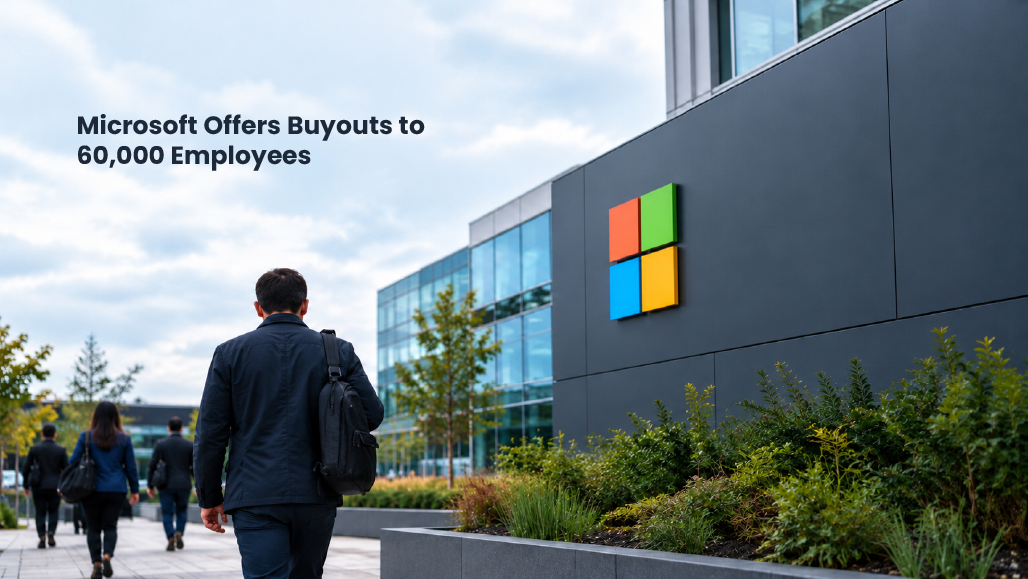

Microsoft is offering buyouts to around 60,000 employees, marking another significant shift in how one of the world’s largest technology businesses is managing its workforce amid an accelerating investment in artificial intelligence.
The voluntary exit programme, announced on October 26, is for eligible employees across the United States, Canada, the United Kingdom and India. The initiative covers employees at internal level 70 and below, including some senior managers and executives, although eligibility varies by team. This programme will affect more than a quarter of Microsoft’s global workforce. However, the company has not indicated how many employees it expects to accept the offer.
The announcement comes amidst the news of Microsoft increasing spending on AI infrastructure. Unlike other traditional layoffs, Microsoft’s latest initiative lets its eligible employees decide if they want to leave. The package is broadly aligned with the company’s standard severance arrangements, including compensation based on seniority and tenure, continued stock vesting for a defined period, healthcare coverage, and career-transition assistance.
In an internal communication, Chief People Officer Amy Coleman described the initiative as a way to give employees considering a move outside the company more choice while helping individual teams adapt to changing business needs.
The approach builds on Microsoft’s earlier voluntary retirement programme, introduced in April 2026. That initiative was limited to a smaller group of US employees who met age and service requirements, and more than 30% of those eligible reportedly accepted the offer. The new programme has a broader eligibility framework and does not impose the same age-and-tenure threshold.
Now for Microsoft, the immediate question is how many eligible employees will accept the offer and how the resulting workforce changes will affect its operations.
The longer-term test is more consequential: whether the company continues to develop AI products, support existing customers and maintain its position while controlling costs. Over the years, we have seen that a smaller workforce does not automatically translate into a more productive organisation. Nor does greater AI spending guarantee commercial success.
However, for now the tech giant is trying to create room for both technological investment and organisational change. So, the outcome will depend on whether it can align its talent, infrastructure and product strategy with the demands of a rapidly evolving market.