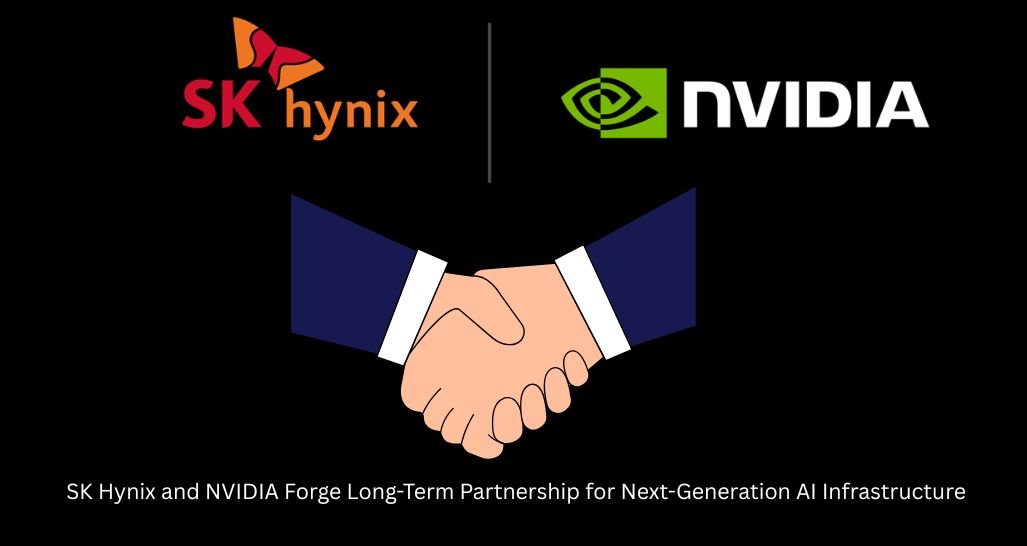


South Korean memory chip giant SK Hynix has entered into a multi-year technology partnership with NVIDIA to strengthen a key relationship that has become one of the most important links in the supply chain powering the global artificial intelligence boom. The agreement clearly focuses on the development of next-generation memory technologies specifically designed for large-scale AI infrastructure and so-called “AI factories,” which are rapidly becoming the backbone of advanced AI systems worldwide.
The announcement was made during NVIDIA CEO Jensen Huang’s high-profile visit to South Korea, where he met with leading executives from the country’s technology and manufacturing sectors. While financial details of the partnership have yet to be disclosed, executives from both companies indicated that the collaboration will extend beyond two years and may be renewed as AI demand continues to accelerate.
At the heart of the agreement is the development of advanced memory solutions for AI data centers. Modern AI systems require enormous amounts of high-speed memory to process increasingly complex workloads, making memory chips one of the most critical components in the AI ecosystem. SK Hynix has emerged as the dominant supplier of high-bandwidth memory (HBM), a specialized type of memory used extensively in NVIDIA’s AI accelerators.
The partnership also reflects a wider shift within the semiconductor industry. Historically, memory chips were often viewed as commodity products, competing largely on production scale and pricing. However, the rise of artificial intelligence has transformed memory into a highly specialized and strategically important component. Analysts increasingly believe future memory solutions will be developed in closer collaboration with customers, creating customized architectures optimized for specific AI applications.
For SK Hynix, the agreement provides an opportunity to expand beyond its traditional markets and participate in emerging AI sectors such as personal AI systems, robotics, and physical AI applications. Company executives said the partnership will help ensure stable memory supply despite the lengthy development cycles required for advanced semiconductor technologies.
The deal comes at a time when demand for AI-related hardware continues to outpace supply. Industry leaders have repeatedly warned that shortages of advanced memory, chip packaging capacity, silicon photonics components, and manufacturing infrastructure could persist for years. During his visit to South Korea, Huang reiterated that supply constraints remain one of the biggest challenges facing the AI industry as adoption accelerates across virtually every sector of the global economy.
The growing partnership also aligns with SK Hynix’s aggressive expansion strategy. Just days earlier, Chey Tae-won revealed plans to more than double the company’s wafer production capacity over the next five years to meet surging AI-related demand. The company currently commands a leading position in the global HBM market and has become one of the biggest beneficiaries of the AI investment cycle.
As AI systems become larger, more powerful, and more widespread, memory technology is emerging as a crucial battleground within the semiconductor industry. NVIDIA’s latest agreement with SK Hynix underscores how deeply interconnected the AI supply chain has become. Success in the next phase of AI development will depend not only on faster processors but also on the ability to deliver advanced memory solutions at unprecedented scale.