
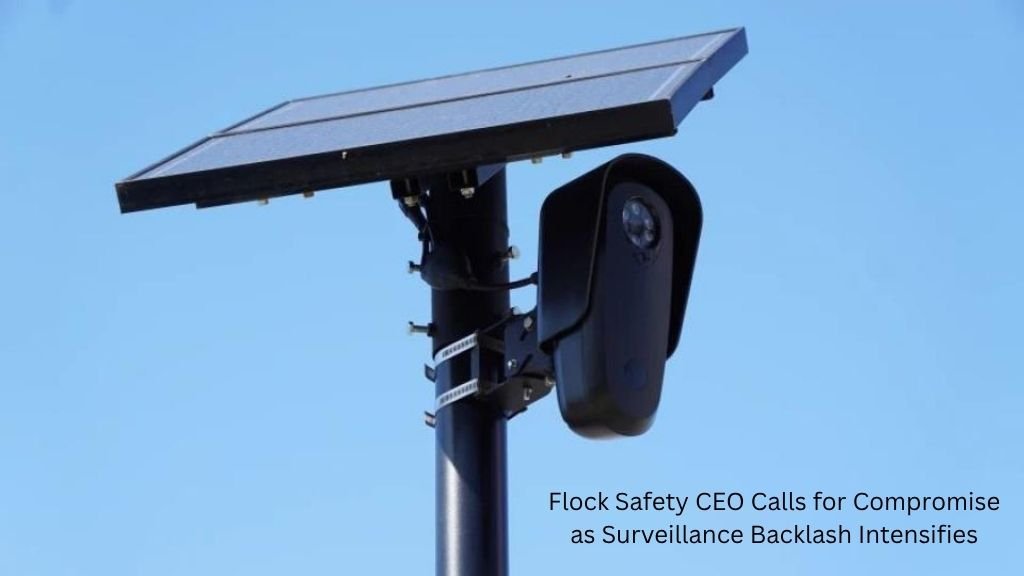


The debate over how far surveillance technology should go to protect public safety is becoming increasingly tough for technology companies. For Flock Safety, one of the most prominent players in the sector, that debate has now reached the company’s leadership.
Flock CEO Garrett Langley is calling for a compromise between privacy and public safety as the company faces growing criticism over the use and potential misuse of its surveillance technology.
In a recent interview with Fox News, Langley argued that treating privacy and safety as competing priorities misses the larger challenge facing society. Instead, he said, the goal should be finding a balance that allows communities to benefit from surveillance technology without giving up reasonable privacy protections.
The comments come at a difficult moment for Flock. The company has built a large business around automated license plate recognition, surveillance cameras, drones and other technologies designed to assist law enforcement. But as its technology has spread, so too have concerns about how the information collected by these systems can be accessed and used.
Growing Scrutiny Over Misuse
Some of the criticism has moved beyond theoretical concerns about mass surveillance.
The Washington Post recently identified 46 cases in which police officers were accused of using Flock’s technology for unauthorized purposes, including allegedly monitoring spouses, partners or former partners. The reports have intensified questions about the safeguards surrounding surveillance databases and who should be permitted to access the information they contain.
Langley has acknowledged the seriousness of such incidents. After hearing from one alleged victim, he apologized for what she experienced while maintaining that Flock itself did not create police misconduct. He argues that the company’s technology can also help identify inappropriate use of surveillance systems.
That distinction, however, has done little to quiet the broader debate.
Flock is increasingly facing criticism from across the political spectrum. Democratic politicians have attacked the expansion of the company’s camera network, while Republican lawmakers have also raised concerns about automated surveillance technologies. Three House Republicans recently introduced legislation that would prevent the federal government from purchasing certain automated surveillance systems involving facial recognition, biometric identification, or license-plate recognition, including Flock cameras.
The bipartisan nature of the criticism underscores how quickly surveillance has become a mainstream technology-policy issue.
Flock Changes Its Policies
The company has already begun changing some of its practices in response to the criticism.
Flock reduced the default period for retaining surveillance data from 30 days to seven days. It also introduced a requirement for users to enter a case code before accessing data.
However, those protections are not absolute. Police departments can override the retention limits through a setting known as Evidence Mode, allowing data to be stored for longer periods.
That flexibility has attracted scrutiny from privacy advocates.
The American Civil Liberties Union said the shorter default retention period could represent progress, but questioned whether the change would provide meaningful protection if Evidence Mode could be used to extend storage. The organization has previously called for significantly shorter retention periods.
Regulation Becomes Part of the Conversation
Langley is now arguing that technology companies should not be expected to solve the surveillance debate on their own.
He has called on state regulators to establish laws making illegal use of Flock data a criminal offense. He has also acknowledged that the wider surveillance technology industry suffers from a lack of consistent regulation and accountability.
That could become an increasingly important issue as surveillance tools become more sophisticated.
Modern systems are no longer limited to recording license plates. Companies are combining cameras, artificial intelligence, drones, and large databases to help law enforcement identify vehicles, investigate incidents, and respond to emergencies. The technological capabilities are expanding faster than the rules governing how those capabilities should be used.
For Flock, that creates both an opportunity and a challenge. Stronger regulation could provide clearer boundaries for customers and technology providers, but it could also restrict some of the ways surveillance systems are currently deployed.
A Bigger Question for the Surveillance Industry
Flock’s situation reflects a broader dilemma facing the rapidly expanding public-safety technology industry.
Law enforcement agencies are under pressure to use technology to improve response times, solve crimes, and operate more efficiently. At the same time, citizens are demanding greater transparency over how their movements and personal information are monitored.
The question is no longer simply whether surveillance technology works. It is whether society can establish rules that determine when it should be used, who can access the resulting data, how long information should be retained, and what consequences should follow when the technology is misused.