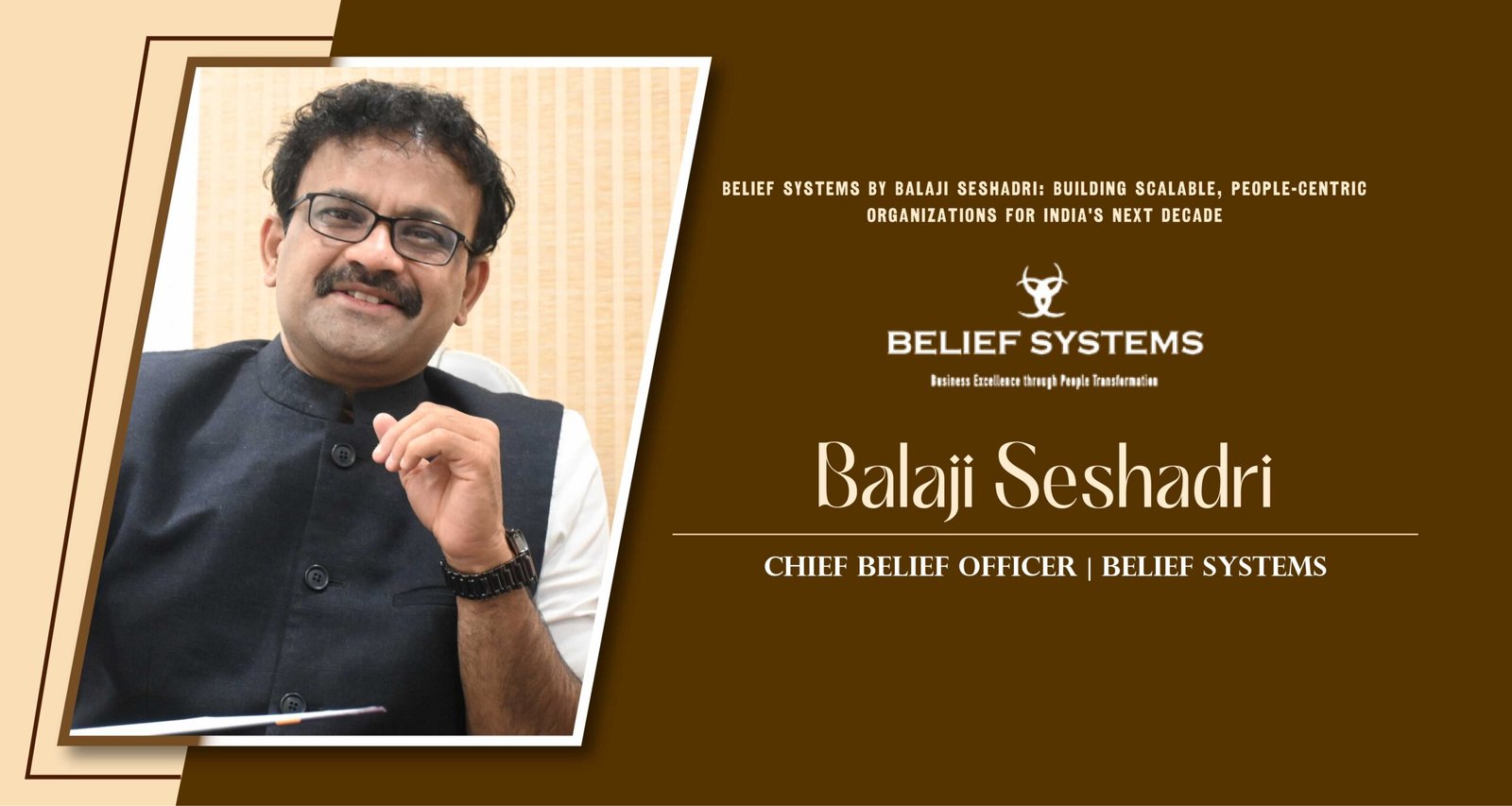


Belief Systems was founded in 2016 by veteran Balaji Seshadri, whose deep roots in human resources and organizational development shaped its mission from day one. While working closely with businesses across industries, a pattern emerged: ambitious founders and capable teams were held back by missing systems, fragmented leadership alignment, and a lack of operational clarity.
That insight sparked the creation of Belief Systems, built on the vision of driving business excellence through people and process transformation. What began as HR consulting has evolved into organizational transformation, leadership development, operational excellence, and culture transformation.
Balaji Seshadri, Founder and Chief Belief Officer (CBO), is a commerce graduate from Vivekananda College and holds an advanced human resources degree from IIM Lucknow. Through training, coaching, and mentoring initiatives, he has transformed thousands of HR professionals and redesigned HR systems for over 240 organizations across industries.
As a business and leadership coach, he has also mentored over 350 entrepreneurs, helping them strengthen conviction in their business models and develop resilient leadership mindsets. Beyond the boardroom, he leads SAKKHI, an NGO focused on empowering transgender individuals through livelihood opportunities and social inclusion.
How Mr. Seshadri’s HR Roots Shaped Belief Systems
Mr. Seshadri’s entrepreneurial journey began with an HR staffing firm, and that experience directly shaped the consulting philosophy behind Belief Systems. Working with multiple organizations revealed that hiring talent alone could not solve deeper organizational challenges.
Many businesses struggled with founder dependency, weak accountability systems, communication gaps, and a lack of leadership alignment. Companies often invest heavily in recruitment while overlooking culture, operational systems, and employee engagement.
This insight led to a core conviction: sustainable growth requires more than hiring the right people. It requires scalable systems, operational clarity, leadership alignment, and a strong workplace culture. That belief became the foundation for Belief Systems’ practical and people-centric approach.
The Core Philosophy behind Belief Systems
Mr. Seshadri describes Belief Systems’ mission as helping organizations become scalable, sustainable, and people-centric. The firm operates on the principle that long-term success requires alignment between leadership, employees, systems, and organizational values.
Its philosophy holds that culture and trust matter as much as business strategy. Strong strategies can still fail if employees do not believe in leadership or feel disconnected from the organization’s purpose.
Belief Systems focuses on building workplace cultures grounded in trust, accountability, collaboration, and transparency. When employees genuinely believe in the organization’s mission and direction, they contribute with greater ownership, commitment, and long-term engagement.
SMEs at the Core: Mr Seshadri on India’s Economic Future
Mr. Seshadri views SMEs and SMBs as central to India’s economic growth. They drive employment generation, entrepreneurship, innovation, and regional development at scale.
India’s growth, he argues, will hinge on how effectively SMEs evolve into professionally managed, scalable organizations. Many SMEs have strong potential but need structured systems, leadership alignment, and operational clarity to scale sustainably.
Belief Systems empowers SMEs through leadership development, process transformation, and employee engagement, creating long-term economic impact and strengthening India’s global competitiveness.
The Growing Pains Mr. Seshadri Resolves
Mr. Seshadri identifies the shift from founder-driven operations to structured systems as one of the biggest hurdles for growing businesses. In many businesses, decision-making and accountability remain concentrated with founders.
As organizations expand, this creates communication gaps, operational inefficiencies, unclear reporting structures, and a lack of middle-management ownership. Without clearly defined KRAs, KPIs, and systems, scalability becomes difficult.
Another challenge is preserving workplace culture during rapid expansion. Businesses often prioritize expansion while overlooking employee engagement and leadership development.
Belief Systems addresses these challenges through leadership alignment, operational clarity, accountability systems, and culture transformation initiatives.
Bridging the Leadership Divide: Mr. Seshadri’s Approach to Alignment
Mr. Seshadri sees the disconnect between strategic leadership and execution teams as a common barrier to transformation. Top management often has clarity on business goals, while middle management faces communication gaps and unclear responsibilities.
Belief Systems bridges this gap through structured communication systems, leadership alignment frameworks, transparent reporting structures, and clearly defined KRAs and KPIs. Leadership coaching and employee engagement initiatives are used to strengthen collaboration and accountability.
The focus, he explains, is to ensure middle management not only understands organizational goals but also feels empowered to drive execution effectively.
The Implementation Gap: Why Process Transformations Fail
Mr. Seshadri points to three recurring mistakes organizations make during process transformation. The first is overemphasis on strategy with too little attention to implementation and employee adoption. Many businesses introduce systems without preparing teams for change.
The second is a lack of leadership commitment. When leadership is not aligned with the transformation, employees struggle to adapt, and changes do not stick.
The third is prioritizing systems while overlooking culture, communication, and employee engagement. Sustainable transformation, he notes, requires balancing operational systems with people-centric leadership.
To avoid these gaps, Belief Systems uses a practical implementation-focused approach that addresses accountability, leadership alignment, communication, and employee engagement together.
How Speaking and Mentoring Sharpen Mr. Seshadri’s Consulting
Mr. Seshadri’s roles of keynote speaker, mentor, and trainer directly strengthen his consulting work at Belief Systems. These platforms create direct engagement with entrepreneurs, business leaders, and professionals across industries.
Through workshops, speaking engagements, and mentoring sessions, he shares practical insights on leadership, organizational transformation, employee engagement, and business growth. They also build awareness around people-centric leadership in modern organizations.
Training and mentoring keep Belief Systems connected to real-time workplace challenges, ensuring its consulting approach stays practical and relevant.
India’s Entrepreneurial Shift in 2026
What excites Mr. Seshadri most about India’s entrepreneurial ecosystem in 2026 is the growing maturity and ambition of Indian businesses. Entrepreneurs today are increasingly open to professional management, digital transformation, leadership development, and long-term organizational thinking.
There is a visible shift from short-term operational survival toward building sustainable and globally competitive organizations. Businesses are also becoming more culture-conscious and people-focused than before.
India’s innovation ecosystem, entrepreneurial energy, and young workforce, he adds, continue creating enormous opportunities across industries.
The Next Decade for Indian SMEs
Mr. Seshadri sees the next decade as Indian SMEs’ defining shift from founder-dependent to professionally managed. Over the next ten years, he expects these businesses to become more structured, technology-enabled, and globally competitive. Businesses will increasingly adopt digital systems, leadership development practices, and data-driven decision-making.
There will also be a stronger focus on employee engagement, operational efficiency, scalability, and organizational culture. Companies investing in leadership alignment and business systems will be better positioned for sustainable growth. Indian SMEs are likely to evolve from founder-centric models into professionally managed organizations with stronger governance and accountability.
Mr. Seshadri’s Blueprint for Indian Business Competitiveness
Mr. Seshadri believes Indian businesses will stay globally competitive only by pairing innovation with execution. He points to five non-negotiables: digital transformation, operational excellence, organizational agility, people-centric leadership, and continuous innovation.
Technology adoption, leadership development, employee engagement, and process optimization will become increasingly important. Businesses that merge robust operational systems with a healthy workplace culture will outpace competitors globally.
Mr. Seshadri sees immediate opportunity in four sectors: advanced manufacturing, AI-driven solutions, global service delivery, and scalable business ecosystems.
Beyond Strategy: Mr. Seshadri’s Closing Message
Belief Systems strongly believes sustainable business success rests on four pillars: trust, clarity, accountability, and meaningful human connection. Systems and strategy matter, but organizations scale only when people truly believe in the vision they are building.
For Mr. Seshadri, leadership today goes beyond operations and P&L. It is about installing confidence, ownership, collaboration, and long-term commitment across every level of the team.
Organizations that balance performance with empathy, structure with culture, and growth with values will continue building resilient, future-ready, and respected businesses.