
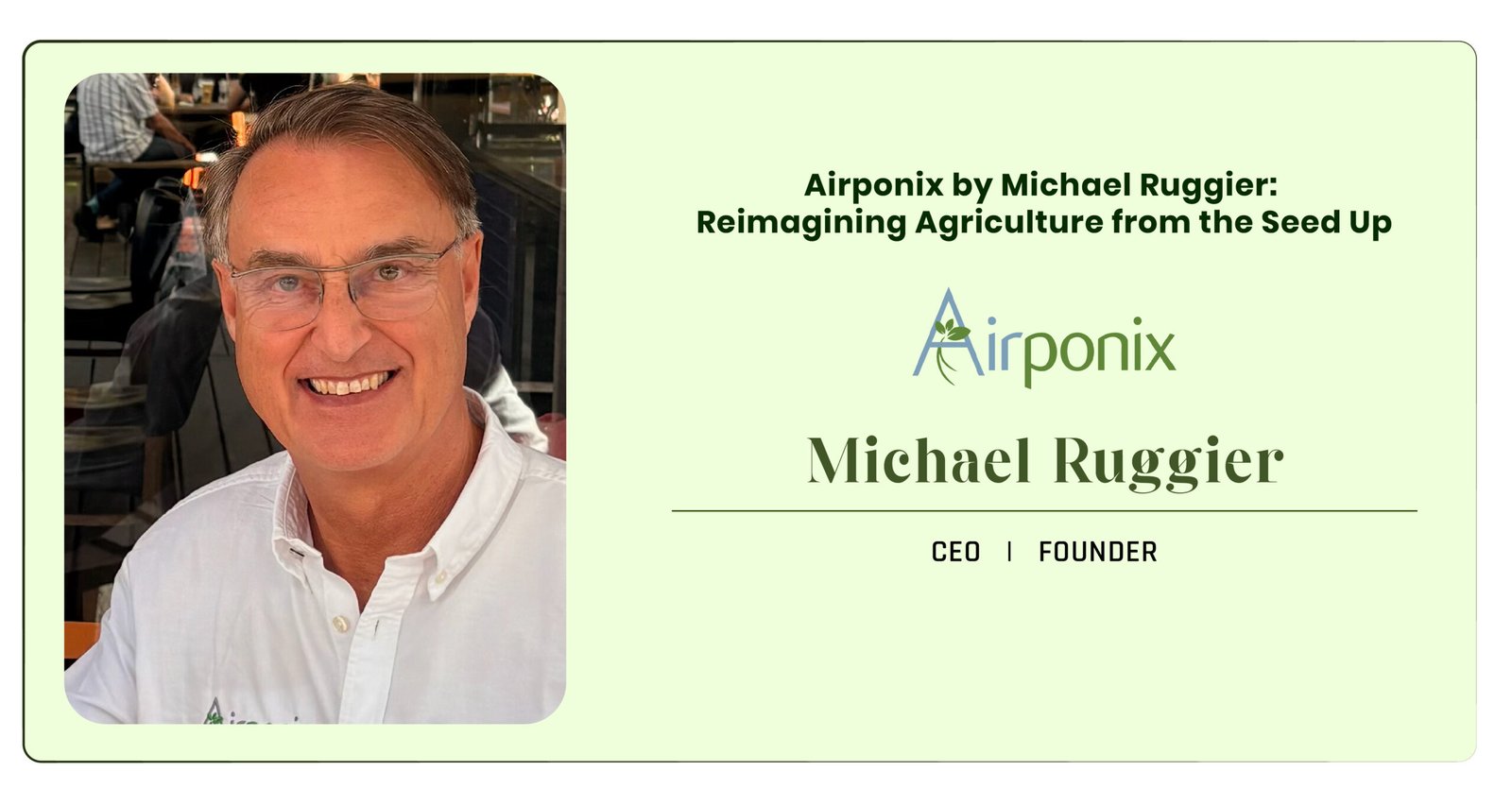


As climate pressures intensify and global food systems strain, innovative farming technologies are no longer optional. They are essential. Airponix is one of the AgriTech firms trying to move the needle, pioneering and redefining how staple crops are produced through advanced aeroponic cultivation. Founded in 2018 by engineer Michael Ruggier, the company is taking on a core challenge: growing food sustainably, at scale, when weather won’t cooperate.
From Energy to Agriculture
Michael Ruggier’s path to agriculture was anything but conventional. He is a chartered engineer with more than 40 years of experience, including 24 years at Shell International; he spent much of his career developing breakthrough technologies across multiple industries. During his final years in Shell’s renowned “GameChanger” department, he specialized in transforming radical ideas into commercially viable innovations.
After leaving Shell, Ruggier founded Gamechanger Technologies to pursue disruptive solutions in four critical sectors: energy, housing, transport, and food. While limited funding prevented simultaneous development of all initiatives, food security quickly emerged as the most urgent priority. That realization led to the creation of Airponix, developed alongside John Prewer, the original inventor of aeroponics and holder of foundational patents in the field.
“At the time, I knew very little about agriculture,” Ruggier says. “But I believed the world would face food shortages long before it ran out of oil or gas. Food was the area where we could make the fastest and biggest impact.”
Ruggier’s Key Learnings
Ruggier’s philosophy has always centered on pursuing transformational rather than incremental innovation. Throughout his career, he focused exclusively on technologies capable of delivering tenfold or greater improvements over existing solutions.
This mindset shaped Airponix’s development from the outset. Rather than improving traditional farming methods at the margins, the company set out to fundamentally redesign how crops can be grown and then focused on producing early-stage seed potatoes.
The result is a proprietary aeroponic growing system that uses ultra-fine nutrient-rich fog to nourish exposed plant roots without soil. The technology dramatically reduces water, land, and energy consumption while significantly increasing productivity, crop consistency, and quality.
Solving a Critical Bottleneck in Global Food Production
Potatoes are among the world’s most important staple food crops, yet the production of high-quality seed potatoes remains a major agricultural bottleneck. Existing methods are decades old, vulnerable to disease, climate disruption, inconsistent yields, and labor-intensive. The global annual seed potato market is US$17 billion, while current supply is consistently struggling to meet the market demand, which is constantly increasing due to increasing population and demand for French fries and snack foods.
Airponix focuses specifically on Generation Zero (G0) seed potatoes, the earliest and most critical stage in the potato supply chain. By producing disease-free starter tubers in controlled environments, the company helps improve downstream crop performance, yield predictability, and food security globally. This is increasingly important as potatoes are a crucial staple food crop with increasing demand, while being more sustainable than rice or pasta.
At the core of the system is a highly efficient A-frame structure measuring 9 meters long, 3 meters high, and 2 meters wide, capable of housing more than 1,500 potato plants while utilizing natural light. Nutrients are delivered directly through an ultra-fine fog system that allows precise, real-time control over plant nutrition, oxygenation, and environmental conditions.
This level of control enables faster growth cycles, greater crop uniformity, and significantly higher output per square meter compared to any other farming techniques.
Sustainable Agriculture at Commercial Scale
One of Airponix’s most compelling achievements is the successful deployment of its technology in some of the world’s harshest climates.
In the Saudi Arabian desert, Airponix provided a turnkey 940m2 facility and operated it for the client, containing 33,000 potato plants across 22 A-frames. The site produces approximately one million G0 seed potato tubers annually while consuming only three cubic meters of water per day.
Remarkably, the facility relies on highly energy-efficient evaporative cooling systems rather than traditional air conditioning. The entire operation uses minimal power while maintaining optimal growing conditions despite extreme external temperatures.
The environmental benefits are substantial:
- Dramatically reduced water consumption
- Minimal land usage through vertical production
- Zero soil dependency
- No agricultural runoff or wastage
- Use of natural light and minimal energy usage
- Elimination of many soil-borne diseases
These efficiencies position Airponix as a leading example of climate-resilient agriculture designed for a resource-constrained future.
A Scalable, Global Business Model
Airponix has developed a capital-light expansion strategy designed for rapid global deployment. Rather than directly funding every facility, the company partners with external partners and investors through project-level special purpose vehicles (SPVs). Revenue is generated through licensing agreements, royalties, management fees, and build-own-operate profit-sharing arrangements.
The company is already expanding internationally. In addition to the Middle East, Airponix is forming a joint venture in Australia to develop a 2,000-square-meter facility expected to supply a substantial share of the country’s G0 seed potato demand while supporting future exports throughout the APAC region.
Meanwhile, Airponix recently secured funding through the UK Government’s Innovate UK Farming Innovation Programme in partnership with Dyson Farming. The collaboration will demonstrate how Airponix technology can accelerate next-generation seed potato development and variety testing more efficiently and cost-effectively than traditional approaches.
Feeding the Future Through Decentralised Agriculture
For Ruggier, the future is local, resilient food systems that reduce dependence on fragile global supply chains.
“Traditional farming will always remain essential,” he explains, “but it will increasingly be supported by controlled, data-driven systems that improve resilience, efficiency, and predictability.”
Airponix’s controlled-environment technology enables reliable seed production regardless of local climate conditions, making it especially valuable in regions facing water scarcity, poor soil quality, or volatile weather patterns.
As the global population approaches 10 billion by 2050, innovations like Airponix may become critical to strengthening food security while reducing agriculture’s environmental footprint.
Looking Ahead
Airponix’s long-term vision extends beyond potatoes. The company plans to apply its proprietary aeroponic technology to additional food crops while integrating deeper automation, data analytics, and AI-driven optimization into future systems.
What started as an ambitious idea from an engineer with no farming background has evolved into one of the most promising innovations in controlled-environment agriculture.
By applying engineering rigor to farming, Airponix is not just improving farming. It is helping redefine how the world could feed itself.