
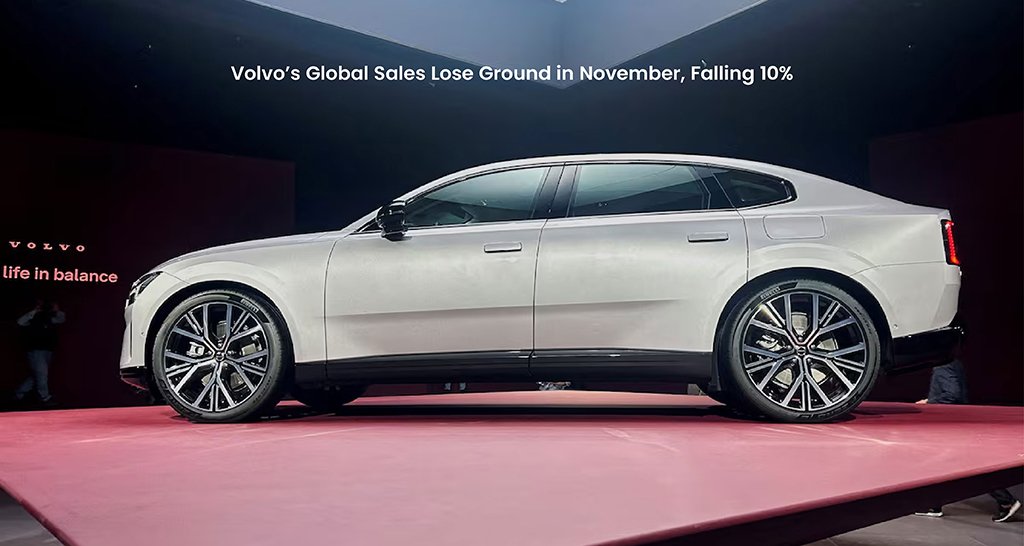


Volvo Cars has reported a 10% decline in global sales for November, which has turned out to be a tough month for the Swedish car manufacturer. The ongoing dip in demand in the United States has been a significant factor affecting their overall performance. In November, the company sold 60,244 vehicles, a drop from last year’s figures, highlighting the ongoing challenges they are facing in several key markets.
According to the company, the drop in sales is mainly due to a sluggish U.S. market, where consumer demand has been cooling off in recent months. Analysts point to a few key reasons for this downturn: high borrowing costs, ongoing economic uncertainty, and fewer incentives for electric vehicles (EVs). These issues have hit premium brands like Volvo particularly hard, as their customers are now being more careful with their discretionary spending.
Despite a general downturn, Volvo has made impressive strides in its electric vehicle lineup. Sales of fully electric models saw a 4% increase compared to last year, making up almost a quarter of all cars sold in November. This growth aligns perfectly with the company’s long-term goal of shifting to a completely electric range. In fact, electrified vehicles, which include both battery electric and plug-in hybrid models, accounted for 50% of total sales, showcasing a significant consumer move towards more sustainable mobility options.
It seems that plug-in hybrid models are struggling a bit, with their performance dropping by 12% compared to last year. This decline has somewhat countered the growth we’ve seen in fully electric vehicles, leading to an overall dip in electrified sales. Industry experts point out that as governments tighten emission regulations and roll back incentives for plug-in hybrids, consumers are increasingly opting for fully battery-powered cars.
When it comes to performance, the XC60 continues to be Volvo’s top-selling model, even though its sales numbers have dipped compared to last year. The XC40/EX40 series is right on its heels, while the larger XC90 has also seen a decline in sales. This trend mirrors a wider slowdown in the global premium SUV market, where competition is heating up and buyers are taking their time to make decisions.
Volvo has recognized that the drop in sales is tied to larger structural shifts happening both within the company and across the industry. The automaker is during a major transformation as it speeds up its transition to electric vehicles, revamps its production methods, and fine-tunes its supply chain to align with new global standards. While these changes are aimed at boosting the company’s long-term competitiveness, they have temporarily impacted monthly sales numbers.
The financial markets had a bit of a tepid reaction to the news, with Volvo’s share price dipping during early trading. That said, the stock is still doing quite well compared to this time last year, which shows that investors are feeling optimistic about the company’s long-term plans for electric vehicles.
Looking ahead, Volvo is keeping its sights set on stabilizing global volumes, boosting efficiency, and growing its electric vehicle lineup. The company is optimistic that the increasing availability of new EV models, along with easing supply chain challenges, could give sales a nice boost in early 2026. However, the sluggish U.S. market continues to pose a significant risk, and much will hinge on how consumers feel and the overall economic climate moving forward.