

In an era where artificial intelligence dominates boardroom conversations and digital transformation agendas continue to accelerate, procurement stands at a defining crossroads. Once measured primarily through savings, sourcing efficiency and transactional excellence, the function is increasingly being called upon to shape resilience, enable growth and drive enterprise-wide strategy.
Yet amid the excitement around automation, analytics and intelligent systems, a more pressing question is emerging: why do some procurement transformations accelerate while others stall?
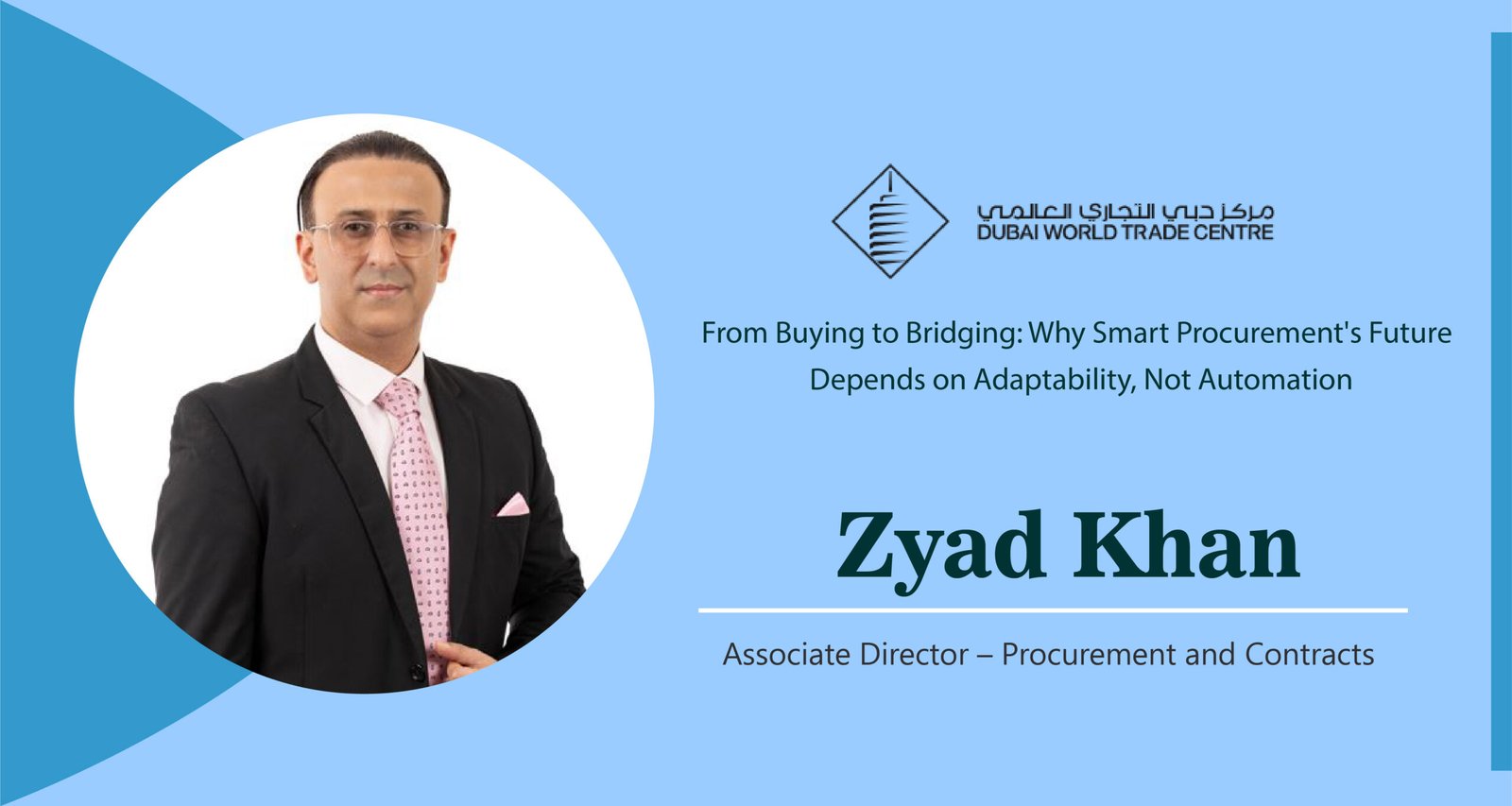
For Procurement Leader and Fellow of the Chartered Institute of Procurement & Supply, Zyad Khan, the answer lies less in technology and more in people. Specifically, it lies in adaptability.
“Organizations often think they are buying transformation by buying software,” Zyad explains. “But Transformation begins with Culture.”
The rise of smart procurement, therefore, is not merely a technology story. It is the evolution of procurement from a transactional discipline into a strategic bridge between people, systems, suppliers, and enterprise value.
Procurement’s New Equation: IQ + EQ + AQ
For decades, leadership conversations emphasized intelligence quotient (IQ) and emotional quotient (EQ) as the defining capabilities of effective professionals. Today, procurement faces a third and arguably more decisive factor: adaptability quotient (AQ).
In a procurement landscape increasingly shaped by AI, predictive analytics, sustainability requirements and supply disruptions, technical knowledge alone is no longer sufficient. Emotional intelligence helps leaders navigate relationships, but adaptability determines whether teams evolve or resist change.
Zyad argues that AI adoption frequently fails not because systems are ineffective, but because organizations underestimate human readiness.
Before evaluating functionality, procurement leaders must ask a tougher question: Is the organization prepared to adapt?
This challenge begins earlier than many realize. Procurement professionals are not simply users of technology; they are often the gatekeepers responsible for selecting, funding and implementing it. That means balancing return on investment, operational readiness and organizational culture simultaneously.
Technology, in this context, is not a cure-all. It is an amplifier.
If culture is rigid, fragmented or resistant, digital tools merely expose those weaknesses faster.
Don’t Buy Transformation. Build It.
One of the most persistent misconceptions surrounding procurement modernization is the belief that efficiency alone constitutes progress.
The reality is more nuanced.
Enterprise systems, ERPs, dashboards, and automation tools have existed for decades yet many organizations still underutilize them. Procurement teams often remain trapped in administrative overload processing approvals, following up on delays, extracting reports and chasing workflows.
The result? Highly capable professionals become expert buyers but struggle to evolve into strategic leaders.
Smart procurement challenges this model.
Instead of asking, How do we process faster? organizations should ask, What work should humans no longer spend time on?
Routine RFIs, transactional sourcing activity, onboarding processes, contract triggers, approvals and supplier workflows increasingly belong to systems. Human time meanwhile should shift toward supplier collaboration, category innovation, sustainability, negotiation strategy and stakeholder influence.
The objective is not workforce replacement.
It is workforce elevation.
As Zyad puts it, procurement professionals must stop measuring value through transaction volume and start measuring it through business impact.
The future procurement leader will not be defined by the number of purchase orders processed but by the quality of decisions enabled.
AI Adoption Is a Leadership Test
Fear remains one of the greatest barriers to technology adoption.
Employees often interpret AI as a threat rather than an enabler, fueling concerns around relevance, displacement, and loss of control. Procurement is no exception.
The response, according to Zyad, is leadership not enforcement.
Transparent communication, inclusion and shared ownership become critical ingredients of successful transformation. Teams that understand why change is happening are significantly more likely to embrace it.
Procurement leaders must actively involve teams in discussions around adoption, gather perspectives and demonstrate practical value early.
Quick wins matter.
When professionals see technology reducing repetitive workload, improving accuracy or eliminating frustrating follow-ups, resistance begins to fade. Trust replaces skepticism.
The challenge becomes particularly important because procurement work remains fundamentally human-centered.
Negotiation, supplier trust, conflict resolution, commercial judgment and stakeholder alignment cannot be outsourced to bots.
AI may surface scenarios, recommend alternatives or improve visibility but relationships still determine outcomes.
In procurement, facts may build the bridge but people ultimately cross it.
From Buyers to Strategic Powerhouses
Perhaps the most significant shift underway is procurement’s changing organizational identity.
For years, procurement was viewed as a support function i.e. a cost controller operating behind the scenes.
That perception is rapidly changing.
Supply chain shocks, inflationary pressures, sustainability requirements, geopolitical uncertainty and post-pandemic/war/conflict disruptions have elevated procurement into a strategic business role.
Organizations increasingly look to procurement leaders for answers during moments of volatility: renegotiating contracts, resolving disputes, balancing supplier continuity and protecting business resilience.
The COVID era accelerated this transition dramatically.
During disruption, companies leaned heavily on procurement not merely to reduce costs but to sustain partnerships, preserve supply continuity and negotiate workable outcomes.
This required something deeper than commercial leverage: Relationship Intelligence.
Zyad challenges the simplistic interpretation of “win-win” negotiations, arguing that sustainable outcomes often require understanding the supplier’s survival as much as organizational objectives.
A squeezed supplier is rarely a sustainable partner.
That realization reframes procurement from a cost function into a value-creation ecosystem built on trust, continuity and strategic visibility.
The Hidden Skill Procurement Must Unlearn
Ironically, one of procurement’s greatest inefficiencies may be hiding in plain sight: follow-ups.
Chasing approvals. Chasing specifications. Chasing vendors. Chasing stakeholders.
For many teams, follow-up consumes hours of daily effort.
Yet excessive follow-up often signals broken processes rather than operational excellence.
Smart procurement requires leaders to ask uncomfortable questions:
Why are approvals delayed? Why are workflows unclear? Why do people depend on manual reminders?
Technology offers dashboards, automated triggers, workflow visibility and escalation systems capable of reducing these burdens significantly.
But automation without diagnosis changes little.
Organizations must first understand the friction points before introducing solutions otherwise they risk digitizing inefficiency.
Procurement as Business Leadership
Perhaps the strongest signal of procurement’s evolution lies in how leadership expectations are shifting.
Increasingly, procurement leaders are expected to think beyond sourcing and toward enterprise strategy. The rise of programs focused on procurement leadership progression i.e. from Chief Procurement Officer to Chief Executive pathways reflects this change.
Why?
Because procurement touches every corner of business.
It sees cost, supplier capability, sustainability risk, stakeholder priorities, operational bottlenecks and market intelligence simultaneously.
That visibility creates strategic advantage.
The procurement professional of tomorrow is no longer a transactional executor. They are a business architect balancing technology with trust, speed with resilience and automation with human judgment.
For organizations pursuing smart procurement, the message is clear:
AI matters. Systems matter. Digital capability matters.
But Adaptability matters more.
Because in the future of procurement, success will not belong to organizations that merely automate faster.
It will belong to those that learn, unlearn, adapt and bridge people with possibility.